DNS and Censorship
Posted on June 25, 2015 · 3 mins reading time
Computers on the internet have IP addresses, and web sites are stored on some of those computers. The Domain Name System - DNS for short - is the way that your computer translates Domain Names (yaleman.org, google.com) into IP addresses. The simplest analogy I can think of is a community-based assistance service which matches people and their street addresses.
A very contrived example:
- **Adam **wanted the street address for **Betty **in Cardiff.
- He looks in his local address book, and it’s not there.
- He calls his directory assistance service who don’t have Betty’s address, so they call someone else on his behalf.
- The “someone else” is one of fourteen international switch boards who direct requests to other local directory services.
- It directs Adam‘s service to the service for Cardiff.
- The Cardiff service provides Betty‘s address - 123 Fourth Avenue.
- Adam visits Betty for tea. Great success!
Replace directory assistance with DNS server, address with IP address, Adam for your PC and Betty with your favourite web site and you get the idea of where we’re going with this.
[Read More]My first easy-out
Posted on June 23, 2015 · 2 mins reading time
Since the front brakes only worked enough to stop you rolling backwards on a slight incline, I figured I had to at least bleed the brakes. To do that, I needed to take the top off the brake fluid reservoir and flush the fluid out.
One of the screws came out nicely after the usual ‘crack’ of breaking the mechanical lock. The other one, not so much. I used a perfectly sized phillips head screwdriver, which promptly made a mess of the steel of the screw. It was like twisting in butter, sadly.
[Read More]I was cleaning the garage…
Posted on June 22, 2015 · 1 min reading time
… and found some injectors I was going to use on another project a decade ago.
I wonder…
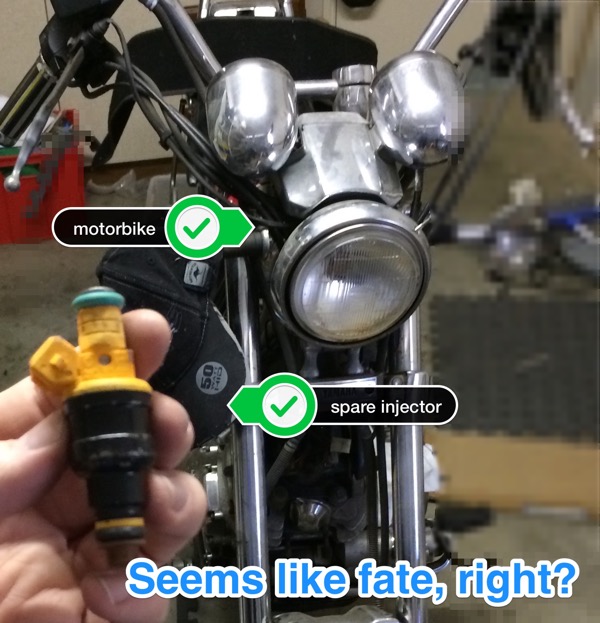 It’s fate, really!
[Read More]Quick update on carb removal
Posted on June 20, 2015 · 1 min reading time
This is a quick video I took of draining the fuel tanks on the Virago last night. More and more I realise that it was a great idea! 🙂
Along with the fuel pump and igniter controls, so far I’ve found some curious Mitsubishi electronics on this bike. The “BOOST SENSOR” is the most curious - it’s actually just a vacuum-activated switch used to change the timing based on engine load.
[Read More]Carbs out!
Posted on June 18, 2015 · 3 mins reading time
After much muttering and wondering what I was doing wrong, I figured it out.
There’s some info on the Virago Tech Forums (registration probably required) also reproduced here because ugh. Here’s how to remove the carburetor on a Virago XV1100.
- Remove the seat
- Remove the right pod and its air cleaner hose
- Remove the left pod and the vacuum line to the (AIS) at the 4 way junction and let it hang down.
- Raise the fuel tank and loosen the upper intake hose clamp for the front carb
- Loosen the lower intake hose clamp and remove the intake hose.
- Remove the throttle cables
- Loosen the upper and lower intake hose clamps and remove the intake hose.
- Remove the fuel lines from the carbs
- Remove the choke cable
- Remove the vacuum lines from the carb holders.
- Loosen the clamp on the rear carb holder and remove the bolt
- Spread open the carb holder clamp for access to the lower carb holder bolt; loosen but do not remove the lower bolt.
- Loosen the carb holder clamp bolt on the front carb and remove the bolt
- Spread open the carb holder clamp for access to the lower carb holder bolt, loosen but do not remove the lower bolt.
- Now, reach over the bike backbone and grab the carbs and twist clockwise and remove the carbs from the carb holders. If the carbs have not been recently removed, this will take some effort.
- From the right side of the bike, slide the carbs back toward the rear wheel. This will give you access to the upper carb holder bolt from the left side of the bike.
- Loosen the upper carb holder bolt on the front cylinder just enough to slide the carb holder out.
- From the right side of the bike, remove the lower carb holder bolt and slide the carb holder out and set it aside. There is enough room to remove it. Don’t remove the bolts - the carb holder should slide off as it’s got a notch in that end.
- From the left side of the bike, slide the carb forward enough to gain access to the top bolt on the rear carb holder from the right side of the bike.
- Loosen it just enough to allow the carb holder to slide out.
- From the left side of the bike, remove the lower carb holder bolt and slide the carb holder out.
- From the left side of the bike, gently maneuver the carbs past the two top carb holder bolts and they will slide right out. You may need to screw one of the top carb holder bolts in a couple of turns to allow the carbs to pass.
This guy’s got the right idea with grinding down his 10mm wrench - I’ll definitely be doing it for the reinstall process. If you try to use the open end of the spanner you’ll likely round down the bolt heads - ask me how I know? 🙁 Luckily a load of G96 loosened up the bolt enough to save my bacon. I’m also going to try that socket wrench idea, that’s fantastic.
[Read More]Quick update
Posted on June 18, 2015 · 1 min reading time
Nothing much to report today, I started disconnecting the wiring to individually test things, as mentioned in a previous post.
I’m fairly sure there was a meeting involved between a load of people to design this… From the battery to somewhere deeper in the loom is this strange arrangement of connectors and a fuse. I’m going to replace the whole thing with an inline fuse holder and a new plug.
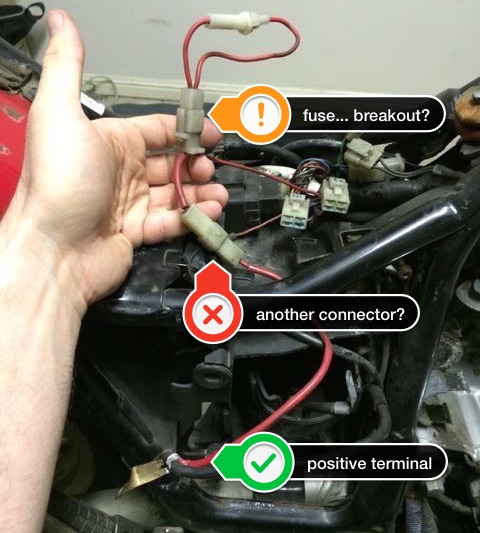 Must have been a meeting
[Read More]First Blood!
Posted on June 17, 2015 · 3 mins reading time
Petrol’s a nasty thing, and carburettors are normally full of it. Until it evaporates - in which case they’re full of nasty ex-petrol-goo. The carbs on the project bike are made of aluminium alloy and they’ve been in the weather by the looks of it, so they’re coated in a lot of nasty white corrosion on the outside. The throttle’s jammed and I’m hoping that’s just a wasp nest or the aforementioned white crap. This is even before I’ve gotten them off the bike!
[Read More]A new project appears! The cruiser.
Posted on June 15, 2015 · 2 mins reading time
Pottering around on the internet as I do, and RMB hit me up about a friend giving away a cruiser. I figure free things are good, and free motorbikes are better! We arranged a time and place and after a few calls around, I snaffled a motorcycle trailer for $73.
Here’s the bike! It’s a Virago XV1100, from 1997 maybe? 🙂
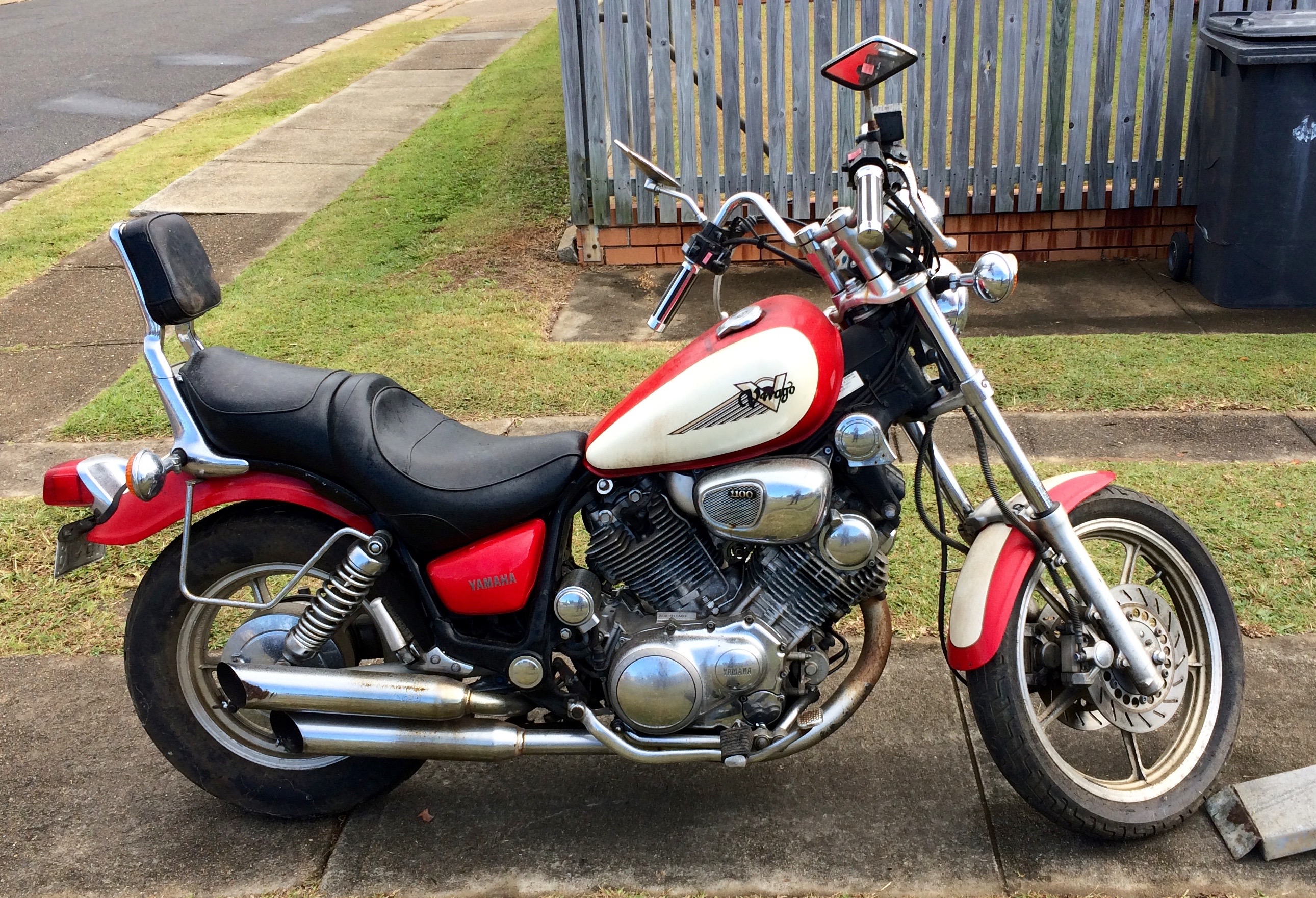 Yamaha XV1100
[Read More]Incapsula SSL Error 29
Posted on June 2, 2015 · 1 min reading time
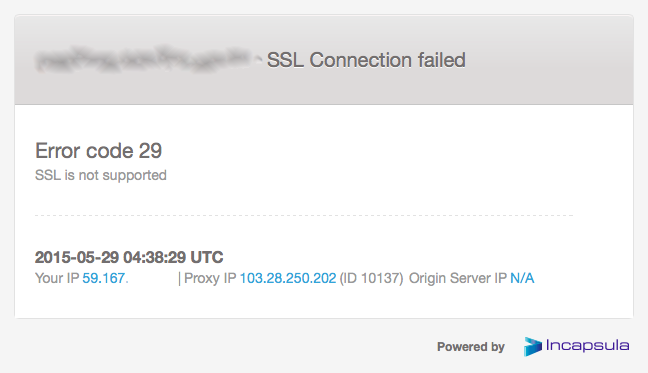
When you get error 29 while trying to access a site ‘protected’ by Incapsula, check the SSL settings for the site. It’ll generally be because the site “has not got SSL” - log a support ticket and they’ll fix whatever they’ve broken.
[Read More]Quick and dirty phone charger
Posted on March 29, 2015 · 2 mins reading time
I wanted to make a quick battery charger just for giggles, the basic requirements were “allows me to plug in a USB cable to charge my phone” - which is fairly easy to accomplish going by all the crazy devices you can buy on the market currently.
I found an eight-pack of C cell batteries at the local Kmart for $5 and I had a few other parts lying around, so I had a go in ten minutes or less.
[Read More]