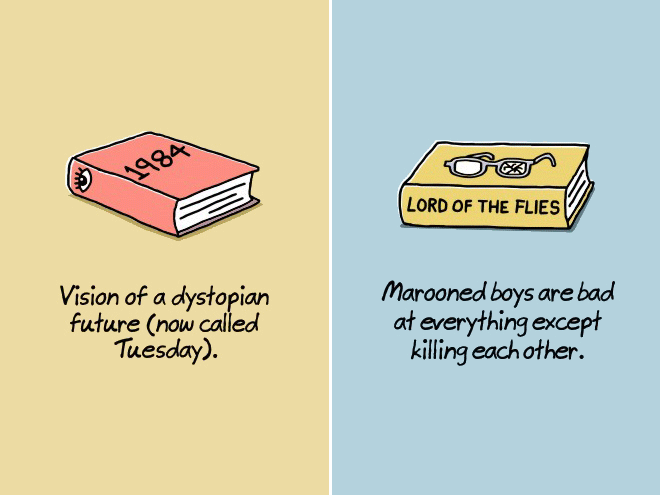
Illustrator John Atkinson has been working hard lately to help you save a lot of time. Thanks to his latest creation you can now read ultra-condensed classic books!
John Atkinson’s blog is a true cavalcade of hilarity!
[Read More]
Illustrator John Atkinson has been working hard lately to help you save a lot of time. Thanks to his latest creation you can now read ultra-condensed classic books!
John Atkinson’s blog is a true cavalcade of hilarity!
[Read More]More and more I realise I missed out on the spectactularly wonderful influence of Mister Rogers growing up. Then again, I’m still happy I grew up in the 80’s, before the TV was truly infested with TellyTubbies and Woogie Poogies or whatever shite they’re spraying over the airwaves these days.
Maxwell King, the former director of the Fred Rogers Center and author of the forthcoming book The Good Neighbor: The Life and Work of Fred Rogers, shared an excerpt of the book with The Atlantic about how much attention Rogers paid to how children would hear the language on the show. For instance, he changed the lyrics on Friday’s installment of the “Tomorrow” song he sang at the end of each show to reflect that the show didn’t air on Saturdays.
[Read More]
Another wonderful summary of a few recent posts and thoughts by Jason Kottke
Another way to put this is that all the people who bought those News of the World-style magazines from the grocery checkout — UFO sightings! Elvis lives! NASA faked the Moon landing! new treatment lets you live 200 years! etc.! — were able to find each other, organize, and mobilize because of the internet. And then they decided to elect one of themselves President.
[Read More]
I’m glad I’m not the only one, this article by Dominik Wagner on Swift puts it better than I’ve ever been able to articulate to myself.
Swift actively distracts me in that endeavor by making me answer questions I really don’t want to answer right now. Yes, stuff might be less correct in the meantime, but heck that is what I want during the design phase. Find my concept, sweet spot, iterate, pivot quickly.
[Read More]
Time formats are a fantastic way to find bugs in your code or even your view of the world. Zach Holman has a great post/rant/talk here about time entitled “UTC is enough for everyone… right?.
It turns out humans have had a long, long history of poorly dealing with time, so when you hammer your head against the wall trying to deal with a timezone bug, well, you’re just the last in a long, long line of human beings that are terrible at all this! Congrats. You’re pretty unremarkable.
[Read More]
I love good bugs. The stories of bug hunts will do when I’m not finding my own.
Diagnosing and fixing a Bug requires patience, thoughtfulness, and above all a systematic, scientific mindset. We must eliminate variables one by one. Persistently forming hypotheses and testing each one is the name of the game. While the poor engineer assigned to hunt the Bug already knows this, it is our tradition to ease the pain by sharing the story of a legendary Bug Hunt.
[Read More]
In a previous post I configured lighttpd to serve proxy.pac files on my pfSense box. Turns out by doing this, I broke the acme.sh package because I was blocking external access to port 80 (because noone needs my PAC file… or something else I break.)
Add the following line anywhere in /usr/local/etc/lighttpd/lighttpd.conf:
include "/usr/local/etc/lighttpd/block-notacme.conf"
Edit the file: sudo vi /usr/local/etc/lighttpd/block-notacme.conf
And add the following contents:
$HTTP["url"] !~ "^/\.well-known/acme-challenge/.*" {
        $HTTP["remoteip"] !~ "10\..*" {
                url.access-deny = ("")
                }
Once done, restart the lighttpd service (sudo service lighttpd restart)
In Photographing the Unbridled Power of a Supercell Storm, AtlasObscura looks at Camille Seaman’s book “The Big Cloud”.
Once they’re in what Seaman calls “chase mode,” there are “no bathroom breaks, there is no stopping for food, no nothing.” At that point, “as things start to actually set up in the storm, our whole objective is to stay with that storm in the right position, which is usually—not always, but usually—the southwest corner of the storm, and follow it safely, so that we can photograph it and see if it produces a tornado.” The goal is to observe and photograph without being in danger. “The worst thing for storm chasers to end up being storm chased.”
[Read More]
Many countries’ veterans struggle to integrate back into civilian life and find purpose outside the military, but the problem is especially acute for legionnaires. Having shed their nationalities and left friends and family behind, foreign-born soldiers often base their identities on the Legion itself. Retirement means losing home, community, and employment all at once … So while the IILE houses wounded veterans, the fields that fill with camo-wearing men picking grapes each harvest address the emotional and financial hardships that former legionnaires face.
[Read More]
From a New York Times article on disasters which strike America, their frequency, location and financial impacts.
Only about 4 percent of all hurricanes that make landfall globally hit the United States, said Robert Mendelsohn, an economist at Yale University who studies the damage caused by hurricanes. Yet 60 percent of worldwide damage from hurricanes happens in the United States.
Dr. Mendelsohn attributed this partly to federal government programs that discourage citizens and local governments from building walls to protect housing near the coast. Only in the United States do relief programs and subsidized insurance make it attractive for people to move toward disaster-prone areas, he said.
[Read More]